Influence of carbon sources on the physicochemical and antioxidant properties of pitaya (Stenocereus sp.) wines
DOI:
https://doi.org/10.56890/jpacd.v28i.617Keywords:
Agave syrup, blosson honey, brown cane sugar, Cladodes, fruit, anaerobic fermentation, gas emission, sheep.Abstract
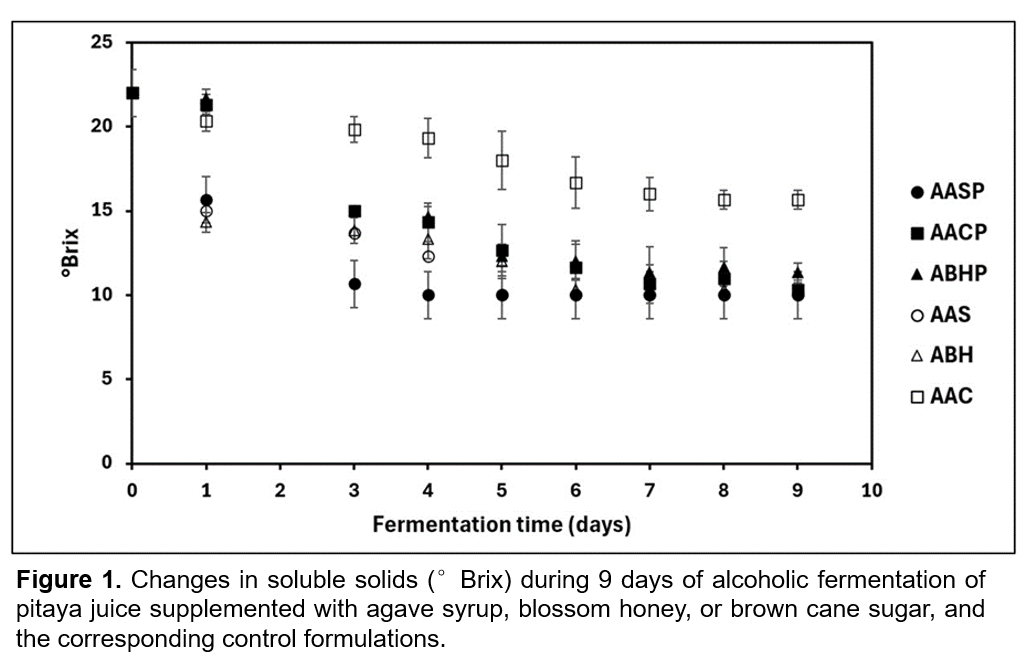
Pitaya (Stenocereus sp.) is recognized for its high antioxidant potential and abundance of bioactive compounds. The aim of this study was to evaluate the effects of supplementing pitaya must with different carbon sources on fermentation performance, physicochemical characteristics, and antioxidant capacity to identify the most suitable formulation for pitaya wine production. Pitaya juices were adjusted to 22 °Brix and fermented with Saccharomyces cerevisiae at 27 °C for 9 days. Fermentation was assessed by soluble solids (°Brix), total reducing sugars (TRS), ethanol production, fermentation yield, and fermentation efficiency. The final beverages were characterized by color, total phenolic content, betalains, and antioxidant capacity using DPPH, ABTS, and FRAP assays. Significant differences (p < 0.05) were observed among carbon sources. All treatments showed a marked decline in °Brix during the first 3-5 days. Pitaya supplemented with agave syrup (AASP) exhibited the highest fermentative performance, reaching the highest ethanol concentration (84.16 g L-1), fermentation yield (0.46 g ethanol/g sugar consumed), and fermentation efficiency (89.71%). The FRAP and ABTS assays showed that AASP after fermentation exhibited the highest antioxidant capacity, with values of 640.90 ± 2.57 and 11,568.33 ± 147.99 ?mol TE mL-1, respectively, whereas the greatest DPPH scavenging activity was observed in agave syrup after fermentation (AAS) (632.11 ± 12.62 ?mol TE mL-1). The highest total phenolic content was observed in agave syrup with pitaya before fermentation (BASP), with a value of 404.94 ± 1.85 mg GAE L-1. These findings demonstrate that agave syrup is the most suitable carbon source for producing fermented pitaya beverages with high fermentative efficiency while preserving their antioxidant potential.
Publication Facts
Reviewer profiles N/A
Author statements
Indexed in
- Editor & editorial board
- profiles
- Academic society
- Journal of the Professional Association for Cactus Development
- Publisher
- Professional Association for Cactus Development

To learn about these publication facts, click 
PF is maintained by the Public Knowledge Project