Phytochemical and functional evaluation of the peels of six varieties of Opuntia spp. from Hidalgo, Mexico
DOI:
https://doi.org/10.56890/jpacd.v28i.620Keywords:
Opuntia spp., food waste, fiber content, antioxidant activity, phenolic compoundsAbstract
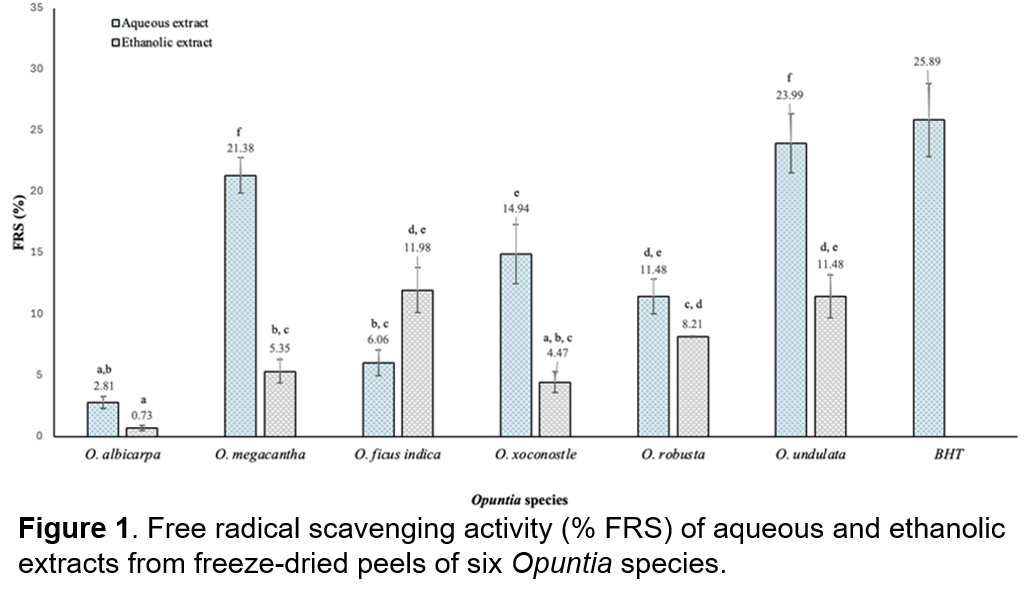
The peels of Opuntia fruits are usually discarded as agri-food waste, yet they are a rich source of dietary fiber and bioactive compounds with potential functional applications. This study compared the phytochemical composition and antioxidant properties of the peels from six Opuntia species native to Hidalgo, Mexico; O. albicarpa, O. megacantha, O. ficus-indica, O. xoconostle, O. robusta, and O. undulata as a function of species identity and extraction solvent (aqueous vs. ethanolic). We hypothesized that interspecific variability in peel chemistry, combined with solvent polarity effects, would produce significant differences in all measured variables. Total, insoluble, and soluble dietary fiber in freeze-dried peel powder were determined. Aqueous and ethanolic extracts were evaluated for radical scavenging DPPH (2,2-diphenyl-1-picrylhydrazyl), antioxidant capacity ABTS (2,2’-azino-bis (3-ethylbenzothiazoline-6-sulfonic acid)), ?-carotene oxidative discoloration inhibition, total polyphenols (Folin-Ciocalteu), and total flavonoids. O. robusta showed the highest total dietary fiber (60.22% d.b.), followed by O. ficus-indica (55.73% d.b.). Aqueous extracts of O. megacantha and O. undulata showed the highest DPPH radical scavenging activity (21.38 and 23.99% FRS, respectively), statistically comparable to the BHT control. ABTS antioxidant capacity was highest in aqueous extracts of O. ficus-indica and O. robusta (91.07 and 90.98 ?mol TE/100 g d.b., respectively). Aqueous extracts consistently outperformed ethanolic extracts in polyphenol recovery, while ethanolic extracts showed higher flavonoid content in most species. The species × solvent interaction was significant for all bioactivity variables (p < 0.05). These results indicate that Opuntia peels from these six Mexican species are a viable source of dietary fiber and bioactive compounds, supporting their use as functional food ingredients and nutraceutical raw materials.
Publication Facts
Reviewer profiles N/A
Author statements
Indexed in
- Editor & editorial board
- profiles
- Academic society
- Journal of the Professional Association for Cactus Development
- Publisher
- Professional Association for Cactus Development

To learn about these publication facts, click 
PF is maintained by the Public Knowledge Project