Chromium Removal from Real Tannery Wastewater by Electrocoagulation Assisted with Prickly Pear (Opuntia spp.) Cladode Powder

Authors

  • Saliha Elabbas 1 Private University of Marrakesh, School of Engineering and Innovation, Agriculture, Environment and Resource Management, Health, Environment, Agri-Food Technologies and Biotechnology Laboratory. UPM University Campus - Km 13, Route d'Amizmiz, 42312 Marrakech. Morocco. 2 Cadi Ayyad University, Faculty of Sciences Semlalia, Water Sciences, Microbial Biotechnologies and Natural Resources Sustainability Laboratory. Bd. Prince My Abdellah, B.P. 2390, 40000 Marrakech Morocco.
  • Nawel Adjeroud 3 University of Bejaia, Faculty of Nature and Life Sciences, Laboratory of Biomathematics, Biochemistry, Biophysics and Scientometry (L3BS), 06000 Bejaia, Algeria.
  • Laila Midhat 2 Cadi Ayyad University, Faculty of Sciences Semlalia, Water Sciences, Microbial Biotechnologies and Natural Resources Sustainability Laboratory. Bd. Prince My Abdellah, B.P. 2390, 40000 Marrakech Morocco.
  • Jean Pierre-Leclerc 4 Laboratoire Réactions et Génie des Procédés, (UMR CNRS 7274), Université de Lorraine,1 rue Grandville, 54001 Nancy cedex, France.
  • Laila Mandi 2 Cadi Ayyad University, Faculty of Sciences Semlalia, Water Sciences, Microbial Biotechnologies and Natural Resources Sustainability Laboratory. Bd. Prince My Abdellah, B.P. 2390, 40000 Marrakech Morocco.
  • Naaila Ouazzani 2 Cadi Ayyad University, Faculty of Sciences Semlalia, Water Sciences, Microbial Biotechnologies and Natural Resources Sustainability Laboratory. Bd. Prince My Abdellah, B.P. 2390, 40000 Marrakech Morocco.

DOI:

https://doi.org/10.56890/jpacd.v28i.622

Keywords:

Prickly pear cladode powder, Chromium, Electrocoagulation, Adsorption, Energy consumption

Abstract

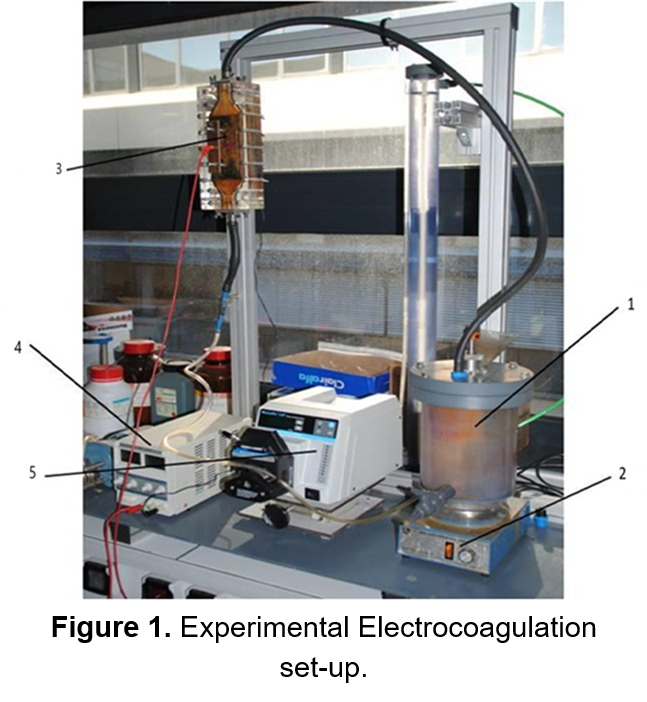
This study investigated the performance of electrocoagulation (EC) coupled with prickly pear cladode powder (PPP) for removing chromium from real chrome-tanning wastewater. Experiments were performed in a batch stirred electrocoagulation cell equipped with two aluminum-based electrodes. The effects of treatment time, current density, initial pH and PPP dosage were examined, with the experiments performed in triplicate using the same wastewater sample. The wastewater initially contained 3.60 g L-1 of chromium (3,600 mg L-1). Optimum conditions were found to be an initial pH of 7.02, a PPP dosage of 20.00 g and a current density of 200 A m-2. Under these conditions, a treatment time of approximately 200 minutes reduced the chromium concentration to 2.00 mg L-1, corresponding to a removal efficiency of around 99.90 %. Compared with EC alone, the EC/PPP process improved chromium removal performance while reducing energy consumption. The specific energy consumption was 3.00 kWh m-3 for EC and 1.50 kWh m-3 for EC/PPP, representing a 50.00 % reduction in energy usage. These results demonstrate that adding prickly pear cladode powder enhances chromium removal and substantially decreases the electrocoagulation process's energy requirements, highlighting the EC/PPP process's potential for treating highly concentrated chrome-tanning wastewater.

Publication Facts

Metric
This article
Other articles
Peer reviewers 
0
2.4

Reviewer profiles  N/A

Author statements

Author statements
This article
Other articles
Data availability 
N/A
16%
External funding 
N/A
32%
Competing interests 
N/A
11%
Metric
This journal
Other journals
Articles accepted 
24%
33%
Days to publication 
224
145

Indexed in

Editor & editorial board
profiles
Publisher 
Professional Association for Cactus Development

Downloads

Published

13-11-2026

How to Cite

Elabbas, S., Adjeroud, N., Midhat, L., Pierre-Leclerc, J., Mandi, L., & Ouazzani, N. (2026). Chromium Removal from Real Tannery Wastewater by Electrocoagulation Assisted with Prickly Pear (Opuntia spp.) Cladode Powder. Journal of the Professional Association for Cactus Development, 28, 326–340. https://doi.org/10.56890/jpacd.v28i.622

Issue

Section

Scientific Papers

Most read articles by the same author(s)