Alternaria alternata and Phoma spp., associated with Necrotic Spot Syndrome in Giant Cardon in Baja California Sur, Mexico
DOI:
https://doi.org/10.56890/jpacd.v28i.628Keywords:
columnar cacti, fungal syndrome, arid zones, phytosanityAbstract
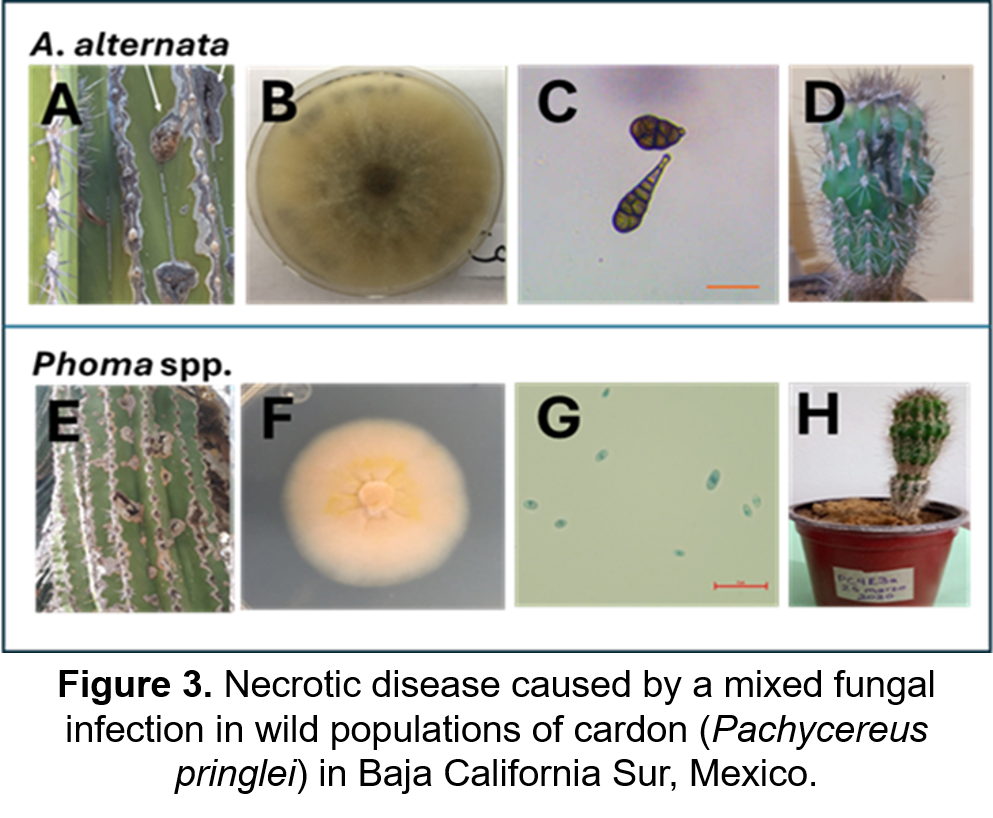
Cardon cacti (Pachycereus pringlei) are an important forest resource in Baja California Sur (B.C.S.), playing a vital role in Mexico's arid zones and carrying ecological, cultural, floristic, and social significance. Over the past two decades, fungal diseases, presumably linked to a necrotic spot syndrome (NSS), have been recorded in the region, causing significant damage to wild populations of this iconic columnar cactus. The causative agents were identified through morphological and molecular characterization, and disease pathogenicity was assessed by measuring severity, incidence, and spatiotemporal recurrence. We identify Alternaria alternata and Phoma sp. associated with necrotic spots on wild cardons, which cause dark brown spots, pustules with a chlorotic halo, small chancres, and concentric circle lesions. Disease intensity of 52.3% can be considered high, with an incidence of 65.3% and a severity of 39.5%. Severity estimates from two independent methods (diagrammatic and lesion range-based) were similar, indicating that both methods can be used to estimate severity. To verify pathogenicity, experimental inoculations were performed to satisfy Koch's postulates, and the resulting symptoms were similar to those observed in the field. This study confirms the presence and spread of fungal diseases in cardon cacti and identifies Alternaria alternata and Phoma sp. as causal agents of the disease NSS. This study contributes to the development of conceptual strategies for preventive actions against fungal diseases in giant cardon cacti in arid zones of B.C.S., Mexico, and worldwide.
Publication Facts
Reviewer profiles N/A
Author statements
Indexed in
- Editor & editorial board
- profiles
- Academic society
- Journal of the Professional Association for Cactus Development
- Publisher
- Professional Association for Cactus Development

To learn about these publication facts, click 
PF is maintained by the Public Knowledge Project