Assessment of fruit ripening status and mass loss thresholds in cactus pear cultivars undergoing room-temperature storage
DOI:
https://doi.org/10.56890/jpacd.v28i.615Keywords:
Opuntia spp., fruit quality, storability, shelf life, fruit appearenceAbstract
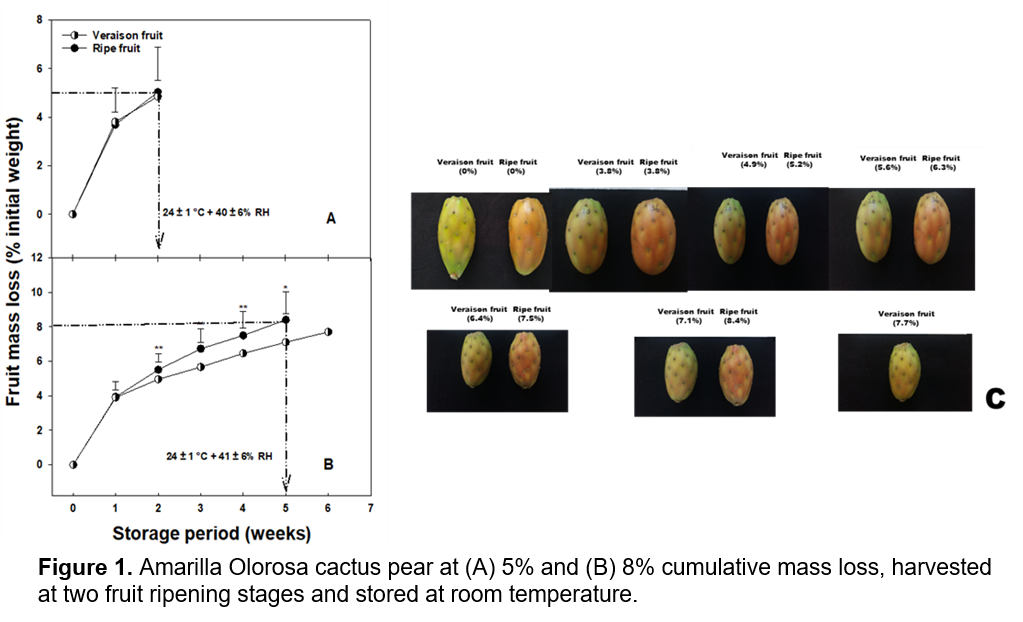
Cactus pear fruit (Opuntia spp.) is an increasingly popular exotic fruit grown in arid and semi-arid regions of Mexico and around the world. This fruit has gained global interest because of its nutritional value, human health benefits, and contribution to food security in marginalized regions. Cactus pear is a non-climacteric fruit; therefore, it is either harvested at the color break (veraison) or ripe fruit (ready-to-eat) stage, depending on the intended market. However, previous postharvest studies have not examined the combination of fruit ripening stage (FRS) with different fruit mass loss (FML) thresholds. This research work aimed the influence of FRS (veraison or ripe fruit) and FML thresholds (5 and 8%) on some quality attributes of white and pigmented cactus pear fruit stored at room temperature. At harvest, veraison fruit of all cultivars had greater flesh firmness but less total soluble solids, peel dry matter and pulp dry matter than ripe fruit, except in ‘Roja Lisa’. The time to reach each FML threshold varied significantly among cactus pear fruit cultivars, indicating each cultivar requires different handling. However, during storage, the FRS at both FML thresholds was similar in all cactus pear fruits, except for Amarilla Olorosa fruit at 8% FML. Fruit decay incidence was not influenced by cultivar, FML, or FRS. After reaching 5% FML, fruit appearance began to deteriorate in all fruits. FML of 8% reduced fruit dimensions, but the other quality attributes responded depending on the cactus pear fruits. In conclusion, postharvest handling during storage depends on the specific cultivar. However, the results indicate that the FML threshold for pigmented cultivars can be set at 5% FML. This information is important for postharvest handling and marketing.
Publication Facts
Reviewer profiles N/A
Author statements
Indexed in
- Editor & editorial board
- profiles
- Academic society
- Journal of the Professional Association for Cactus Development
- Publisher
- Professional Association for Cactus Development

To learn about these publication facts, click 
PF is maintained by the Public Knowledge Project