Water deficit and extreme temperatures inhibit seed germination of Echinocereus cinerascens (DC.) Lem.
DOI:
https://doi.org/10.56890/jpacd.v28i.625Keywords:
Cactaceae, Mexican Plateau, Temperature regimes, Water potentialAbstract
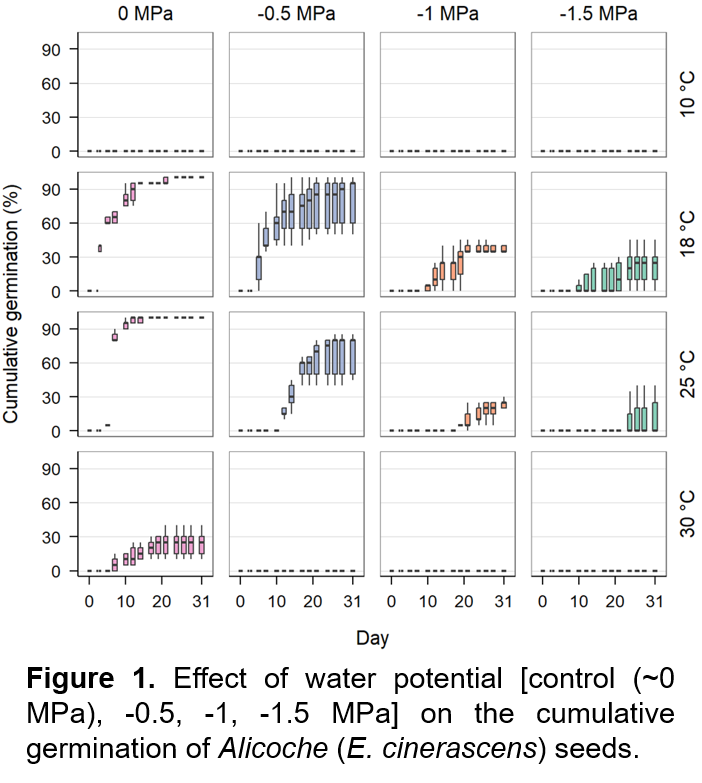
Cactus Echinocereus cinerascens is a cactus of ecological and cultural importance in the Mexican Plateau; however, fundamental knowledge regarding its seed germination remains scarce. This study evaluated germination response under different temperatures (10, 18, 25, and 30 °C) and water potentials (well-hydrated, -0.5, -1.0, and -1.5 MPa), using filter paper as substrate. Germination was recorded over time, and germination parameters were analyzed. The seeds achieved germination percentages exceeding 95 % under well-hydrated conditions at 18 and 25 °C within 10 to 17 days. In contrast, no germination was recorded at 10 °C, as well as at 30 °C under moisture restriction (-0.5 to -1.5 MPa). Progressive substrate dehydration significantly reduced the germination percentage and increased the time to the onset of germination and time to 50% germination, with median values falling below 20% and exceeding 15 and 20 days, respectively, at -1.5 MPa. These effects were exacerbated when combined with higher temperatures. Furthermore, temperature and hydration levels that deviate from optimal conditions increased variability in germination variables suggesting a bet-hedging strategy. Seed germination of E. cinerascens is remarkable under temperature and moisture levels but dehydration and unfavorable temperatures inhibit it. Sexual propagation of this species, based on seed germination, is a viable method.
Publication Facts
Reviewer profiles N/A
Author statements
Indexed in
- Editor & editorial board
- profiles
- Academic society
- Journal of the Professional Association for Cactus Development
- Publisher
- Professional Association for Cactus Development

To learn about these publication facts, click 
PF is maintained by the Public Knowledge Project