Cactus pear management alternatives in Brazilian savannah: agronomic aspects, chemical composition, macro and micronutrient content

Authors

  • João Paulo Matos Pessoa 1 Federal University of Piauí. Campus Ministro Petrônio Portella, Bairro Ininga, Teresina, PI. CEP: 64049-550.
  • Samila Barbosa Lisboa 1 Federal University of Piauí. Campus Ministro Petrônio Portella, Bairro Ininga, Teresina, PI. CEP: 64049-550.
  • Dhiéssica Morgana Alves Barros 1 Federal University of Piauí. Campus Ministro Petrônio Portella, Bairro Ininga, Teresina, PI. CEP: 64049-550.
  • Gleice Kelle Silva Marques Vilela 1 Federal University of Piauí. Campus Ministro Petrônio Portella, Bairro Ininga, Teresina, PI. CEP: 64049-550.
  • Shirlenne Ferreira Silva 1 Federal University of Piauí. Campus Ministro Petrônio Portella, Bairro Ininga, Teresina, PI. CEP: 64049-550.
  • Maysa Callado Moura 1 Federal University of Piauí. Campus Ministro Petrônio Portella, Bairro Ininga, Teresina, PI. CEP: 64049-550.
  • Clara Beatriz Marques da Silva Xavier 1 Federal University of Piauí. Campus Ministro Petrônio Portella, Bairro Ininga, Teresina, PI. CEP: 64049-550.
  • Marcos Lenyn Rodrigues dos Santos 1 Federal University of Piauí. Campus Ministro Petrônio Portella, Bairro Ininga, Teresina, PI. CEP: 64049-550.
  • Alexandre Fernandes Perazzo 1 Federal University of Piauí. Campus Ministro Petrônio Portella, Bairro Ininga, Teresina, PI. CEP: 64049-550.
  • Francinaldo Nunes Pessoa-Filho 1 Federal University of Piauí. Campus Ministro Petrônio Portella, Bairro Ininga, Teresina, PI. CEP: 64049-550.
  • Luan Felipe Reis Camboim 2 Federal University of Campigna Grande, Rua Aprígio Veloso, 882, bairro Universitário, Campina Grande, PB, CEP: 58429-900.
  • Leane Veras da Silva 3 Federal Institute of Education, Science and Technology of Maranhão. Rodovia BR-230, Km 319, Zona Rural, São Raimundo das Mangabeiras, MA, CEP 65840-000.
  • Ricardo Loiola Edvan 1 Federal University of Piauí. Campus Ministro Petrônio Portella, Bairro Ininga, Teresina, PI. CEP: 64049-550.

DOI:

https://doi.org/10.56890/jpacd.v28i.588

Keywords:

cladode, cutting intensity, harvest, Nopalea cochenillifera

Abstract

The cactus pear is a plant that can survive and produce under the soil and climatic conditions of tropical regions, but its management is still relatively little known in the Brazilian savannah. The objective of this study was to evaluate management alternatives for the cactus pear variety Doce, subjected to different cutting intensities, preserving the matrix, primary or secondary cladodes, and two harvest ages (annual and biennial), under rainfed conditions in the Brazilian savannah. A completely randomized design was adopted in a 3 × 2 factorial scheme, with eight replications. Morphometric and production variables, chemical composition, as well as macro and micronutrient contents were assessed. Greater amounts of green forage mass yield (GFMY) and dry forage mass yield (DFMY) were found when up to the primary cladode was preserved, but the crude protein content was like that found in the matrix cladode cutting intensity. Managing the cactus pear under biennial harvest provided higher height, GFMY, DFMY, potassium, and micronutrient accumulation. The management alternative that provides the most benefits in terms of agronomic characteristics and production is the one that preserves up to the primary cladode associated with biennial harvest. In addition, biennial harvest provides better chemical composition and greater accumulation of macro and micronutrients in cactus pear cultivar Doce.

Publication Facts

Metric
This article
Other articles
Peer reviewers 
2
2.4

Reviewer profiles  N/A

Author statements

Author statements
This article
Other articles
Data availability 
N/A
16%
External funding 
N/A
32%
Competing interests 
N/A
11%
Metric
This journal
Other journals
Articles accepted 
21%
33%
Days to publication 
295
145

Indexed in

Editor & editorial board
profiles
Publisher 
Professional Association for Cactus Development
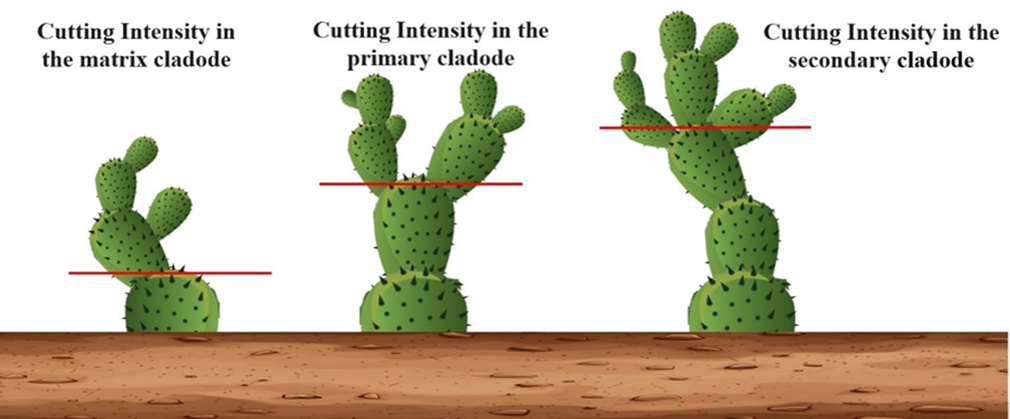
Figure 2. Cutting intensity of cactus pear variety Doce according to treatment, preserving the Matrix, Primary and Secondary cladodes.

Downloads

Published

04-02-2026

How to Cite

Matos Pessoa, J. P., Lisboa, S. B., Barros, D. M. A. ., Vilela, G. K. S. M. ., Silva, S. F., Moura, M. C., Xavier, C. B. M. da S., Santos, M. L. R. dos ., Perazzo, A. F., Pessoa-Filho, F. N. ., Camboim, L. F. R., Silva, L. V. da, & Edvan, R. L. (2026). Cactus pear management alternatives in Brazilian savannah: agronomic aspects, chemical composition, macro and micronutrient content. Journal of the Professional Association for Cactus Development, 28, 13–27. https://doi.org/10.56890/jpacd.v28i.588

Issue

Section

Scientific Papers

Most read articles by the same author(s)